
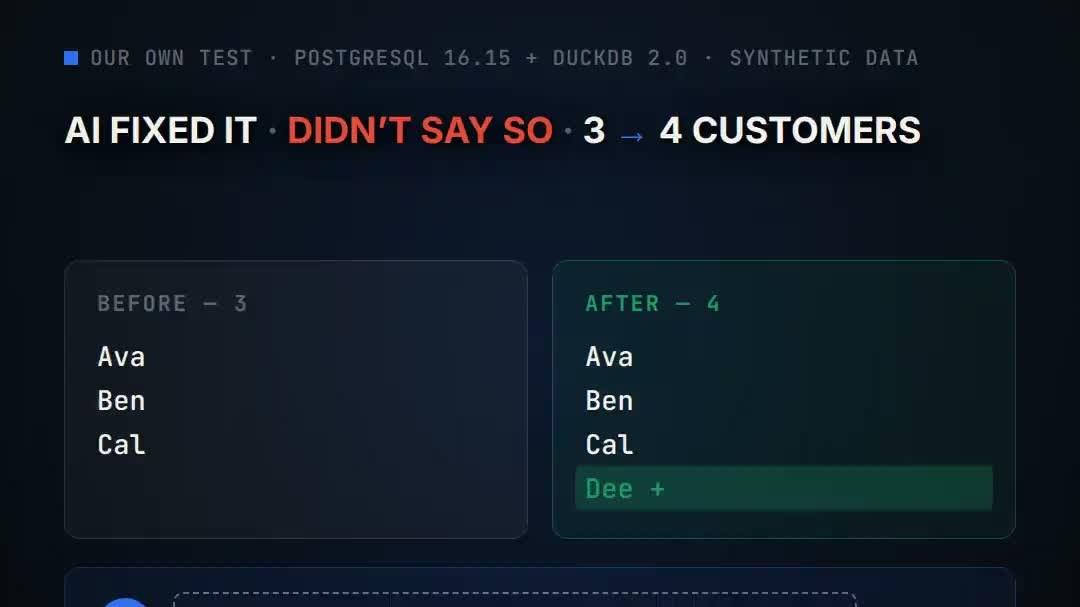
We asked two AI models to add one column to a win-back list query: each customer’s total October spend. Both models did the ask. Both also fixed a bug nobody mentioned, and neither said a word about it. The list went from 3 customers to 4.
The 45-second reel: AI fixed our bug without telling us.
The bug
Our win-back list was meant to list every customer with their October order count, including zero. The query filtered October in the WHERE clause. On a LEFT JOIN, that turns the join into an inner join: the customer with no October orders drops out of the result entirely. That customer was Dee, and Dee is the exact person a win-back email is for.
The old query returned 3 rows:
| Customer | October orders | October spend |
|---|---|---|
| Ava | 2 | $180.00 |
| Ben | 2 | $120.00 |
| Cal | 1 | $200.00 |
Dee is missing. No error, no warning. The query ran fine and returned a wrong list.
What the models did
We gave the query to two AI models from one provider, one try each, and asked for one thing only: add each customer’s total October spend as a third column. Both models moved the date filter from the WHERE clause into the ON clause of the join. That is the right fix. The list came back with 4 customers, Dee included at zero orders and $0.00. Neither model left a comment or a note about the change.
The prompt stated the list’s intent, to include zero, and asked for a column only. Nobody asked for a fix.
The fixed query returned 4 rows:
| Customer | October orders | October spend |
|---|---|---|
| Ava | 2 | $180.00 |
| Ben | 2 | $120.00 |
| Cal | 1 | $200.00 |
| Dee | 0 | $0.00 |
The fix
A silent fix is still a change. The output changed shape, one row appeared, and nothing in the reply said so. If that query feeds a churn email, the extra row is the win. If it feeds a report, the extra row is a number that moves with no explanation. Either way, the check is the same: diff the output every time AI edits a query. Run the old query and the new one side by side and look at what changed, not just whether it ran.
What we did not verify
This was our own test on synthetic data, run Nov 1, 2026, on PostgreSQL 16.15 and DuckDB 2.0. Two models from one provider, one try each. It is a small test, not a benchmark, and it says nothing about how often AI fixes bugs it was not asked to fix. The voiceover in the reel is AI-generated. Watch the reel on Threads.
This post started as an Instagram post →
- https://www.instagram.com/reel/DfTNnFzjv3L/
- https://www.threads.com/@dataeng.ai/post/DfTN409ut5v
- https://www.postgresql.org/docs/current/queries-table-expressions.html
Numbers above trace to these sources. If one moved, tell us and we fix it.
Talk it through
Argue with us on Instagram.