
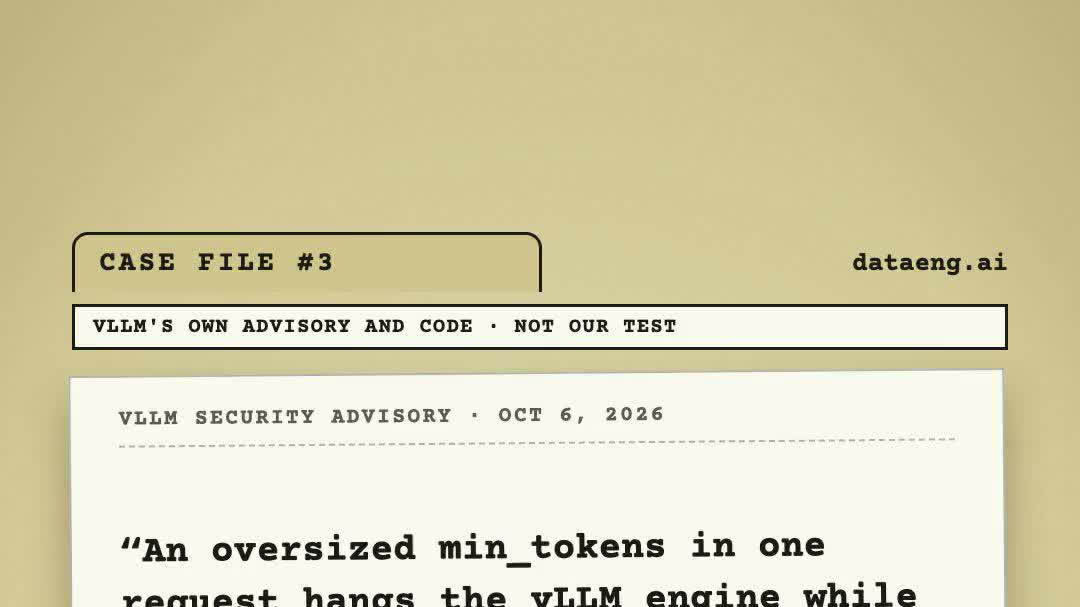
A vLLM security advisory says one bad request can leave a server alive, but not serving. The health check keeps answering 200 while every generation request hangs. The advisory is GHSA-4xqp-c3mv-qff7, published October 6, 2026, rated Moderate with a CVSS score of 6.5, affecting versions before 0.31.0. The advisory’s own words: “The process stays alive and /health keeps answering 200, so nothing restarts it.”
The 38-second reel: the server that stayed healthy after it stopped serving.
The mechanism
The check that min_tokens may not exceed max_tokens runs only when max_tokens is set. On the /inference/v1/generate route, a request that sets max_tokens to null skips the check in the API process. The input processor then fills a maximum in. The engine’s decode runs the check a second time, and it raises one line above the try. The advisory says: “The exception is not caught, so the thread exits.”
That thread was the only reader of the input socket. It is checked only at start-up, and the health check only looks for a recorded error. So the server keeps answering 200 while every generation request hangs. The OpenAI routes check first and return HTTP 400, so this request never reaches the engine through them.
The advisory describes the trigger as one 92-byte request. Its example values are max_tokens null with an oversized min_tokens. The route was mounted by default in v0.29.0; in our reading of the code, it is opt-in from v0.30.0.
The fix
Fix PR 57731, merged September 22 and shipped in v0.31.0 on October 5, rejects that request with 7 added lines in input_processor.py. The pull request changed 3 files, adding 64 lines and removing none: 7 lines in input_processor.py and 57 lines of tests. It is not in v0.30.x.
The fix changed neither the thread nor the health check. PR 55771, merged September 29 and in v0.32.0, says: “The engine-core bug itself is still open.” PR 58481, a community member’s fix for the engine-side gap, is not merged as of October 21. Issue 58445, which describes the engine-side gap, is open.
One thing has been run, by a contributor rather than by us. PR 55771’s test run on main reports that a different bad request, [true] as a prompt token id, stopped the engine-core input thread, and “Chat then hung for 60 s while /health returned 200, and the server had to be restarted.” That trigger was closed by PR 55771 itself in v0.32.0.
The lesson
A flag-only health check cannot see a dead thread. The health check reads recorded error state, not thread liveness, and we found no code path that sets it when this thread dies. If your server went deaf, what would notice first? A probe that sends a real request with a timeout could. “Deaf” is our word, not the advisory’s.
What we did not verify
We did not run vLLM. None of the sources we read shows the min_tokens request run against a live server, and the advisory shows no reproduction. Our findings come from the advisory text and a code reading at v0.32.0 and main, done October 20 and 21. The Python /health route and a single engine only were traced; the Rust frontend and data-parallel shapes were not. Whether an uncaught thread exception prints a traceback to the logs is unverified, so “nothing reports it” stays the advisory’s wording, not our claim. PR 55771, PR 58481, and issue 58445 are contributor posts, not vLLM statements. Dates are UTC. Watch the reel on Threads or YouTube.
This post started as an Instagram post →
- https://www.instagram.com/reel/Dex6GYRD_H_/
- https://www.threads.com/@dataeng.ai/post/Dex6cPhj2rZ
- https://www.youtube.com/shorts/XF8Jpy075B0
- https://github.com/vllm-project/vllm/security/advisories/GHSA-4xqp-c3mv-qff7
- https://github.com/vllm-project/vllm/pull/57731
- https://github.com/vllm-project/vllm/pull/55771
- https://github.com/vllm-project/vllm/pull/58481
- https://github.com/vllm-project/vllm/issues/58445
Numbers above trace to these sources. If one moved, tell us and we fix it.
Talk it through
Argue with us on Instagram.